From Belief to Bombs - How Faith Becomes a Weapon
My very first job out of college was teaching Economics and Philippine History at Philippine Science High School. On my first day in each class — and many of my former students still remember this — I would start with one question: “Do you believe in God?”
I’d call on someone at random. If they answered yes, I’d ask how could they possibly know for sure? On the rare occasion that someone said no, I’d challenge them too, and ask why. I would always take the contrary position and switch sides easily. It usually didn’t take long for the room to come alive, a mix of conviction and discomfort settling in.
I suspect, for most of them, it was the first time anyone had seriously questioned something they had always believed in, and unquestioningly assumed to be settled.
In the end, I would share that I personally do believe in God. But that that wasn’t the point.
The point was that in my class, nothing — whether it was religion, history, or economic doctrine — would be handed to them as something to accept without friction. If we were going to talk about how societies organize themselves, how power is exercised, or how truths are constructed, then they had to learn to challenge ideas, and not simply regurgitate them.
I was reminded of the folly of failing to question belief after seeing US President Donald Trump and his equally shameless VP JD Vance have the audacity to wave the banner of religion (or in Trump’s case, to cast himself as Jesus healing the sick), lecture no less the Pope on matters of theology, and attempt to use that to justify their bombing of innocent people in Iran and Gaza.
To be sure, there’s something reassuring about religion when the world starts to feel like it’s coming apart at the seams. Not the loud, performative version you see on TV or shouted from podiums, but the quieter kind — the kind that, like poetry or music or art, gives you an opportunity to realize, “You’re not the first to feel lost, you won’t be the last, and things will get better.”
At its best, religion is less about answers and more about orientation. It gives you a kind of moral compass when the map is missing. It offers principles — compassion, restraint, love, justice — that are meant to outlast the chaos of any particular moment. That kind of grounding is always, very very much needed.
But let’s also be careful about romanticizing religion.
Religion, like everything else humans touch, is imperfect. Not just occasionally flawed, but structurally so — because it is interpreted, enforced, and lived by people who are themselves inconsistent, biased, and prone to convenient readings when it suits them.
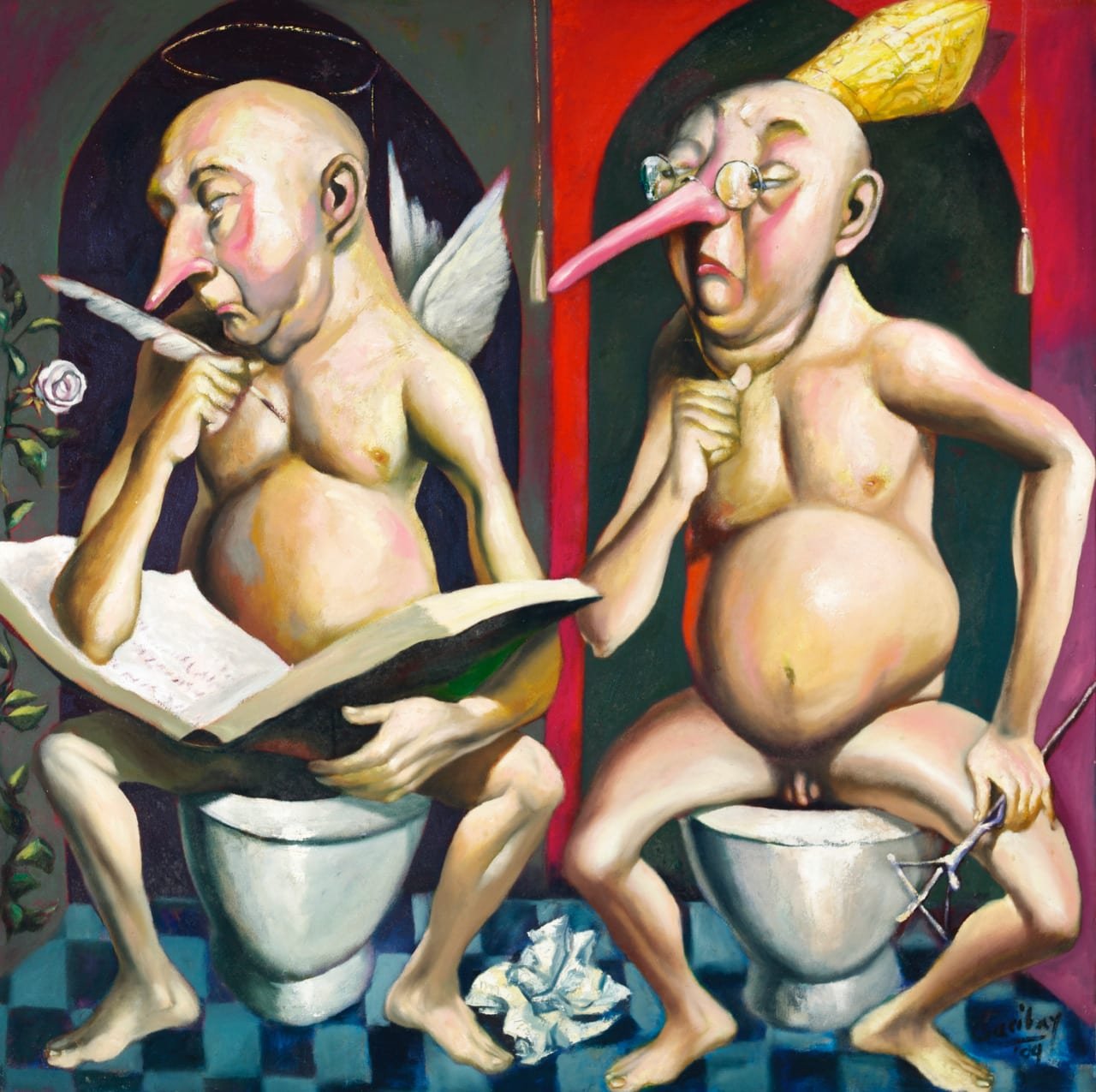
So if religion is to be our guide, we have to accept that it cannot be read in black and white. The Bible, the Quran, and all other sacred texts must be read, I believe (and I know there will be those who would not agree), as living documents that demand engagement, questioning, and most important of all, responsibility.
Even assuming, however unlikely, that the sacred texts have not changed, the way we wield them does. And that will say more about us than about the intents of the Divine.
The exercise of faith, then, has to be a continuing personal commitment. We have to wrestle with it. Revisit it. Doubt it. Refine it.
And that brings us to one of the most crucial parts of practicing religion: humility.
If you truly believe in something — deeply, sincerely, with your whole being — it should make you more cautious, not less. Because conviction without humility can easily turn into imposition. And imposition, especially when dressed up as righteousness, rarely stays benign for long.
History is littered with people who were absolutely certain they were doing the right thing.
From the Crusades to the Inquisition, horrendous acts were committed in the name of the Catholic Church. Entire populations were displaced, converted, or killed because someone was certain their God was on their side.
Apartheid in South Africa found comfortable shelter in selective, contorted readings of scripture that placed whites above everyone else.
There are extremist Muslim leaders who have similarly invoked religion to justify the oppression of women, and the persecution — and execution — of those who they thought offended Islam with their words and art, as well as those deemed to have violated moral codes, such as members of the LGBTQ community.
And of course, the United States, in its conquest of the Philippines, dressed imperial ambition in the language of the “white man’s burden”, enabling it to sound righteous and gloss over its atrocities.
When religious belief hardens into entitlement, it doesn’t just exclude — it dehumanizes. We are watching that play out today in the actions of states like the United States and Israel — governments and leaders, not necessarily their people — as they cavalierly invoke religion to justify war, and all its inhuman consequences.
It is nothing less than arrogance and hubris — bombs dropped in the name of peace, suffering (up to and even mass starvation) justified as necessary, and dissent dismissed as ignorance or even heresy.
In the hands of Trump, JD Vance and Netanyahu, religion is not a guide. It is a weapon. Which is why they are so eager to take it out of Pope Leo’s hands.
What’s especially unsettling is how quickly people can fall in line behind these narratives. Perhaps because it’s comforting. It’s easier to believe, after all, that your side is not just strategically correct, but morally ordained. It removes the burden of doubt. It simplifies the story. Good versus evil, with you firmly on the right side of history — or so you tell yourself.
That simplicity is a trap.
Because the moment you believe there is only one valid path, you’ve already stopped listening. And when you stop listening, you can start justifying. And once you start justifying, nearly anything is permissible.
If religion is meant to bring us closer to Truth, then it should also make us more aware of how limited our perspective is. There is a difference between walking your path with conviction, and insisting everyone else must follow it — or else.
Maybe that’s the paradox at the heart of it all: the stronger your faith, the more room it should make for uncertainty. Not because your beliefs are weak, but because you recognize that understanding the Divine, or the Sacred as my friend Manny Garibay says, is an ongoing and never-ending process.
There are many paths to the Truth. What matters is whether we’re walking ours in a way that reflects the very principles we claim to believe in. The danger begins when we mistake our path as the only one and decide that others must suffer for not walking it with us.
Artwork credit: “Ang May-Akda” by Emmanuel Garibay (Oil on canvas, 2007)