A Policy Agenda for the Creative Economy
May 8, 2026
The other day, I was invited to speak at a panel for “Inoblasyon”, the University of the Philippines’ Innovation Summit.
Preparing for it gave me an opportunity to step back and think about creativity, the creative economy, and the kinds of policies I would want to see if we were serious about treating creativity not as a side issue, but as an integral component of national development (which, to be fair, it already is at least on paper).
It also made me reflect on CANVAS.
I’ve always thought of CANVAS primarily as a nonprofit that publishes books, mounts exhibitions, works with artists, and develops projects around literacy, the environment, and social development. Which is true. That is what we do.
But now, more than twenty years later, I’ve slowly come to realize that what we are actually working toward is something larger.
Not just projects, but infrastructure. Cultural infrastructure. Imaginative infrastructure. The kind that shapes how children see themselves, how communities imagine possibilities, and how a country prepares for the future.
That realization did not come all at once, much less from the start. It emerged slowly over the years of doing the work and repeatedly running into the same questions.
Why do so many Filipino children grow up without owning books?
Why are public cultural spaces for children so rare?
Why is creative work often treated as secondary to “real” development?
How can art and storytelling help advance issues we care deeply about — children’s rights, environmental awareness, national identity, technology and society?
And now increasingly: what role can creativity play in helping children navigate a rapidly changing world shaped by algorithms, AI, and digital systems?
Once you begin asking those questions seriously, thinking about policy becomes difficult to avoid.
And if CANVAS were ever asked what kinds of policies we believe could genuinely strengthen literacy, creativity, and the cultural sector in the Philippines, I think our agenda might look something like this.
1. Every Filipino Child Should Own Books
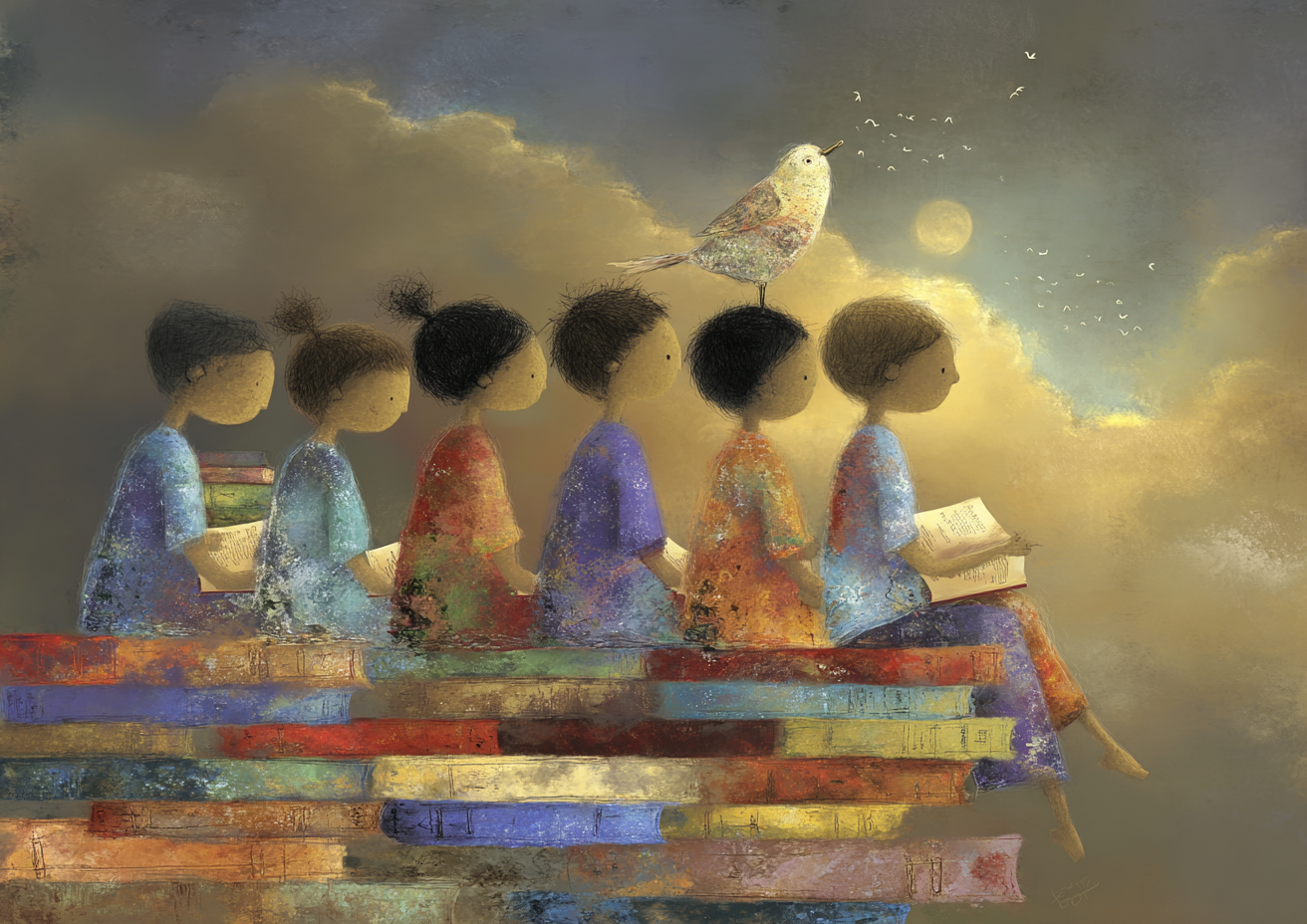
One of the simplest but most important things we’ve learned over the years is that many Filipino children do not own books at home.
Not “good books.” Not “quality literature.” Any book.
That matters more than we sometimes realize.
Research consistently shows that the presence of books in the home is strongly associated with improved educational outcomes. And in a country where many children who begin elementary school never finish high school, early and sustained access to books matters enormously.
But beyond the research, we’ve also seen this firsthand.
A child who owns a book experiences it differently from a child who merely borrows one. Ownership changes the relationship. A book becomes part of memory, imagination, and identity.
We already understand the importance of nutrition, healthcare, and classrooms in child development. Access to books — beyond schools and into homes — should be understood with the same seriousness.
We should have a serious national strategy that ensures:
children directly own books,
especially during early childhood,
using Filipino-created stories and illustrations,
and making books part of everyday family life, not just classroom life.
2. We Need More Public Spaces for Imagination
The Philippines has malls. It has commercial spaces. It has entertainment spaces.
It has very few public spaces intentionally designed for children to wonder, reflect, imagine, and engage creatively.
Working on trying to raise funds and build our Tumba-Tumba Children’s Museum of Philippine Art helped me realize that museums and storytelling spaces are not luxuries. At their best, they are spaces where communities build curiosity, empathy, memory, and belonging.
Not every town needs a massive institution. But a town with even just a small creative space already has the potential to fundamentally change a child’s sense of possibility.
I think there is room for policies that actively encourage:
children’s museums,
storytelling parks,
community creative hubs and libraries,
interactive public art,
and small cultural spaces outside Metro Manila.
3. Educational Content Should Not Feel Emotionally Dead
Children remember stories.
They remember images.
They remember feeling.
Which is why I think there is a strong case for integrating more artist-led, story-centered, culturally rooted creative work into education itself.
Not as decoration, and not just to make books look prettier, but as a core educational strategy.
I have the impression (and would love to be proved wrong) that many if not most of the books our public school students read contain educational content that may be technically correct (if that), but are emotionally forgettable.
And yet the lessons children remember most are often the ones attached to narrative, emotion, beauty, humor, surprise, or wonder.
If done properly, this can also strengthen the broader creative ecosystem by creating sustainable opportunities for:
writers,
illustrators,
designers,
publishers,
researchers,
and regional creative industries.
If we want a stronger creative economy, then government has to think seriously about nurturing the ecosystems that allow creative work to survive and mature.
4. Children Need Digital Wellness and AI Literacy
This is one of the areas I think will become enormously important over the next decade.
Children are entering a world where algorithms increasingly shape attention, AI shapes information, and digital systems influence identity, self-worth, and behavior.
But many conversations around technology remain trapped between two extremes:
either blind optimism or moral panic. Very little of it is grounded in child development.
The Philippines needs a more thoughtful framework around:
AI literacy,
digital wellness,
attention awareness,
deepfake literacy,
algorithmic manipulation,
and healthy relationships with technology.
A framework that is not fear-based, nor anti-technology. One that is human-centered. It must be rooted in reflection, creativity, and critical thinking rather than blind dependence on systems children barely understand.
The challenge is not simply access to technology, daunting as that already is. It is learning how to preserve our humanity and nurture independent thinking in the middle of systems increasingly designed to shape how we think, feel, and behave.
5. The Creative Economy Cannot Survive on Passion Alone
The Philippines talks more and more about the creative economy now, which is encouraging.
But many creative workers are still economically vulnerable: writers, illustrators, musicians, performers, animators, designers, filmmakers, and cultural workers.
Many have no choice but to work informally, inconsistently, and precariously.
If the country is serious about developing its creative industries, then it also has to be serious about sustainability:
fair compensation,
better contracting standards,
intellectual property awareness,
social protections,
financing mechanisms,
and long-term ecosystem support.
6. Reform How Government and Philanthropy Fund Social Impact Work
One of the structural problems in the nonprofit and creative development sector is that too much funding is designed around projects rather than institutions.
The result is that creative workers and organizations spend enormous amounts of time surviving instead of building.
They move from show to show, or grant to grant. From proposal to proposal. From one-year cycle to one-year cycle.
And because funding is often tightly restricted, organizations are often prevented from spending money where they actually need it most: retaining good people, strengthening operations, building systems, investing in long-term planning, experimenting, documenting, and creating enough stability to think beyond the next deadline.
Underlying many funding structures — both governmental and philanthropic — is an assumption that beneficiaries cannot be trusted unless every peso is tightly micromanaged.
So grants become unreasonably constrained and deeply constraining.
“This amount is only for printing.”
“This can only be used for transportation.'“
“This amount is only for workshops.”
“You cannot buy from that sari-sari store if it cannot give you an official receipt.”
"All of it must be used before December 31.”
Organizations then have to quickly scramble to secure the next cycle of support, even as they try to navigate the rules surrounding existing funds.
Meaningful institution-building will not happen if organizations are permanently trapped in survival mode.
Ironically, many funders already understand this privately. They know that the strongest organizations are often the ones given enough trust and flexibility to evolve organically. Yet structurally, the system still rewards short-term outputs over long-term capacity.
Government agencies, philanthropic institutions, and even CSR programs should begin allocating a meaningful portion of their support toward:
multi-year funding,
unrestricted operational grants,
and long-term institutional partnerships.
I am not asking funders to blindly give away funds. Accountability still matters. Transparency still matters. Measurable impact still matters.
But once trust has been established, they must recognize that organizations themselves are often in the best position to determine where resources are most needed. And in many cases — I say this from CANVAS’ own experience — a relatively small unrestricted grant sustained over several years can create far greater long-term impact, than a much larger but heavily restricted one-time project grant.
Stability matters.
An organization with predictable long-term support can hire and retain better people, invest in strategic planning, develop stronger programs, take creative risks, build infrastructure, and pursue deeper, slower, more meaningful work.
It can think five years ahead instead of merely year to year. And that matters especially when we’re trying to address problems (like those in literacy and education) whose roots are structural, entrenched, and decades in the making.
Some of the world’s strongest nonprofits and cultural institutions were not built through constant precarity. They were built because someone trusted or organized them with intention and room to grow.
The Philippines still tends to fund social impact work as if every organization were temporary.
If we want stronger institutions — institutions capable of shaping culture, public life, and national development over decades — then we also need funding systems designed around continuity, trust, and long-term imagination.
What ties all these ideas together, at least for me, is the belief that creativity is not ornamental.
Imagination, creativity, emotional literacy, storytelling, and cultural access are strategic national capacities. The challenge, then, is to move beyond simply “supporting the arts” and begin understanding and taking serious steps to address what is truly at stake.
Creativity shapes how people think, learn, connect, solve problems, and imagine futures.
I honestly believe that the countries that will thrive in the coming decades will not simply be the ones with the strongest economies or the most advanced technologies.
They will be the ones most capable of nurturing imaginative, thoughtful, creative, and emotionally resilient people.
Because ultimately, creativity is not separate from development. It is part of how societies adapt, endure, and move forward.
And it all begins with our children.